Less Stuff, More Peace - Part 1
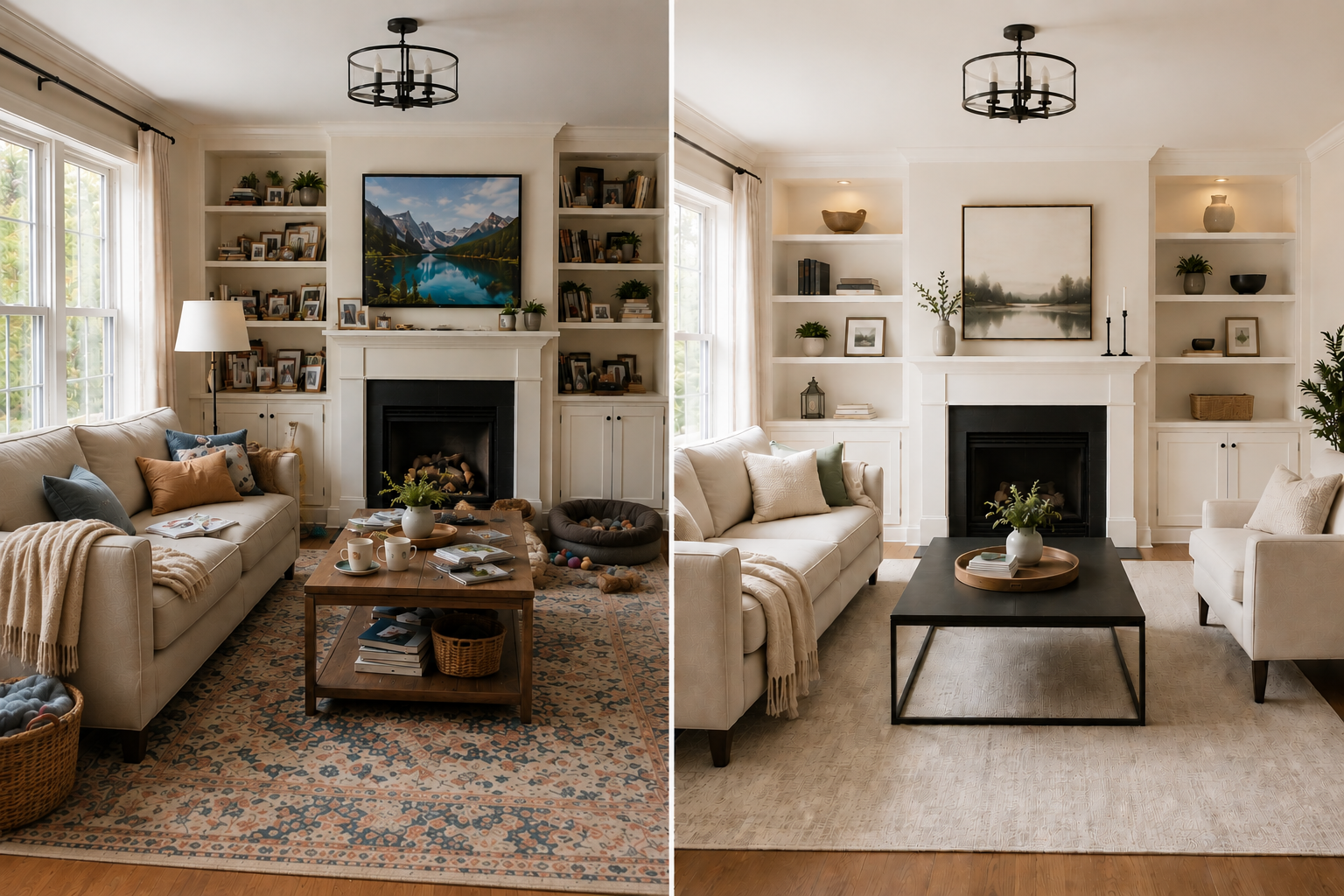
As a follow-up to “A Time to Clean,” this is the first of a two-part series on organizing and decluttering. As I said previously, Spring cleaning is not necessarily decluttering. Decluttering is something to do on a regular, ongoing basis. This first part will discuss minimalism and “house hushing.” “House hushing” or “quieting the house” involves minimizing visual noise, creating a calm and peaceful atmosphere. For God is not a God of disorder but of peace, as in all the meetings of God’s holy people. (1 Corinthians 14:33 NLT) God’s character promotes peace and harmony, order and stability, and lack of chaos.
Minimalism, or the “less is more” philosophy for design, is often attributed to Ludwig Mies van der Rohe, who advocated that simplicity, clarity, and doing away with unnecessary elements creates functionality, elegance, and impactful effects. Some definitions of minimalism from Dictionary.com include: “An aesthetic, particularly in design, decor, and fashion, favoring simplicity, clean lines, and neutral colors over pattern, ornament, and brighter colors.” and “A lifestyle involving a reduction or simplification of one’s material possessions that frees one to lead an existence that is more intentional, purposeful, spiritual, etc.” Interesting that the minimalist design, and minimalist practices, leads to a minimalist lifestyle. That lifestyle — living intentionally, purposefully, and spiritually, surely sounds ideal.
And He said to them, “Take heed and beware of covetousness, for one’s life does not consist in the abundance of the things he possesses.” (Luke 12:15) My mantra has always been that I want the least that I need to be comfortable and happy. Of course, this amount of “stuff” would be different for everyone; but it still remains that the more you have, the more you have to take care of. An added benefit of having minimal things is that it minimizes the amount of time and energy you must expend to maintain a neat and clean home. This frees up time for you to spend doing the things that matter and bring you joy.
For we brought nothing into this world, and it is certain we can carry nothing out. (1 Timothy 6:7) In her article, “Maximalisma,” Lisa Russ Spaar discusses cleaning out her belongings as she ages in order to save her children the task of doing so. She had experienced relatives who had sorted their belongings and relatives who had not, and witnessed what a difference it made. Some were borderline hoarders. She cites that hoarding, originally considered to be a subset of obsessive-compulsive disorder, now is its own separate diagnosis in the DSM (Diagnostic and Statistical Manual of Mental Disorders). Ms. Spaar moved through her things methodically and at a comfortable pace, paring down her belongings to what was truly important to her — and removing things she potentially did not want her children to see. Ultimately, sparing her children those decisions.
I personally find clutter to be unnerving, even claustrophobic. I feel so much better after cleaning out and organizing. During a podcast of the American Psychological Association (Speaking of Psychology), Dr. Joseph Ferrari, a professor of psychology, defined clutter as “an overabundance of possessions that collectively can create chaos and disorderly living spaces.” Do not lay up for yourselves treasures on earth, where moth and rust destroy and where thieves break in and steal; but lay up for yourselves treasures in heaven, where neither moth nor rust destroys and where thieves do not break in and steal. For where your treasure is, there your heart will be also. (Matthew 6:19-21) Dr. Ferrari goes on to say “...we’re not called to live as paupers. Christ never tells you to do that. He said the problem isn’t abundance. It’s attachment to the abundance.” In studies he has conducted that look at areas such as livability of space, emotional consequences and distress, he discovered that “...the more clutter you have, the lower people report life satisfaction. Greater the stress.”
This brings us to the idea of house hushing. Much research has shown that the physical environment has a direct affect on one’s emotional state. In a Country Homes & Interiors article, “How Do You Hush A Home,” Michelle Halford states “ Clutter, for example, has been linked to heightened stress levels and decreased focus, while harmonious, well-balanced environments can enhance relaxation and productivity.” From her book, The Quiet Home, “A hushed home is not about adhering to a particular style, but rather about fostering an atmosphere that resonates with your own sense of balance and comfort — tuning in to what feels right, quieting what feels excessive and creating a home that serves as a true retreat.” It is so important for our homes to be our refuge and safe-haven. In my next installment, we will be looking at various decluttering and organizing methods and strategies. Stay tuned to find one that works for you.
